So this has been a long time coming, but I’ve finally made some headway on some design work (thanks in part to some regular dev streams) for the next Essay Games project. The scope, content, and themes of the work are much larger in scale than anything I’ve ever worked on, but I’ve been feeling really encouraged by some close friends to pursue this project and have been able to secure a little bit of added financial support thanks to a Research Seed Grant at Pratt (where I’m now an assistant profession if you hadn’t heard).
I should probably make a much more detailed post about what the heck this project is, but for now I’ll say that I’m working on a game about the Flood of Johnstown, Pennsylvania in 1889. The flood happened when a man-made dam burst at the Hunting and Fishing club (whose members included Andrew Carnegie) after a massive storm and as a result of systemic poor maintenance. I’ve been researching this project on and off for a long time (since making The Trolley, actually), but I started to actively start developing it around the start of 2026.
I’m still figuring out the shape of the gameplay and probably need to do some preliminary playtesting, but for this post I wanted to dive into some of the narrative system work I’ve been developing. The bulk of what I’ve been working on came during a sprint of motivation at the end of the summer and occurred after presenting at NarraScope. After getting some good feedback / responses / discourse, I tried to channel a lot into working on the story design of this game.
My last blog post highlights some of the narrative / story stuff I’ve been thinking about since then, but I wanted to write about the system design ideas that were also sparked by looking at, studying, and critiquing narrative games as part of that talk. Namely, that central premise of what I was critiquing―”meaningless” choice―was something I was continuing to perpetuate in the development of this Johnstown project. So I started to develop a dice mechanic that would be tied to choices which would pair a mechanical “expression” with choice “flow.”
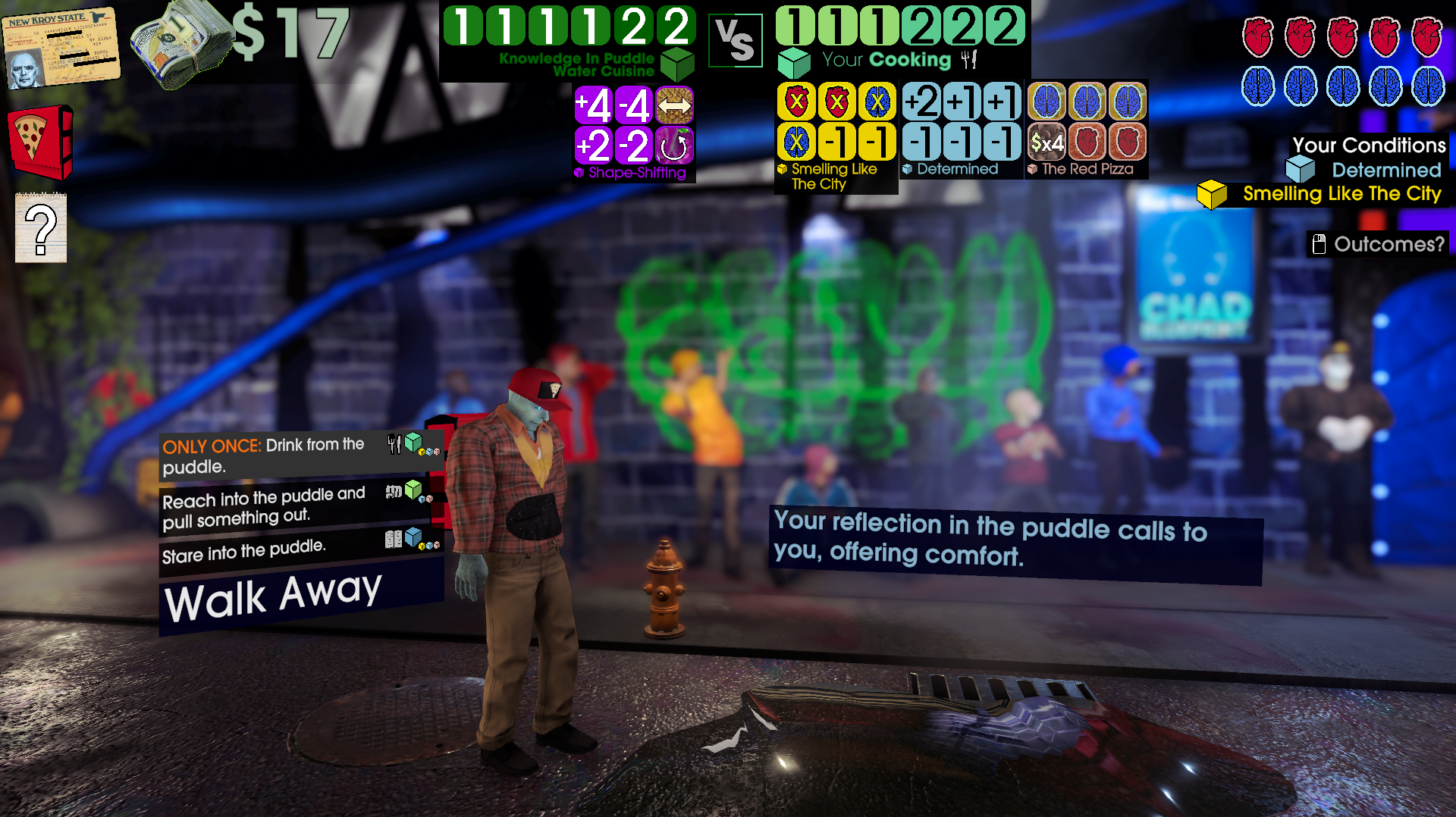
To start, I was heavily inspired by the way that Cosmo D designs his narrative encounters as contested dice rolls. In his games Betrayal at Club Low and the upcoming Moves of the Diamond Hand, the player tries to gain knowledge/overcome a challenge/curry favor/etc with NPCs choices that are mapped to skill dice. Making strategic decisions about how to employ those dice is the central “loop” of the game (from a mechanical/system perspective). I started to implement this concept by making each NPC in my game have a moment of “challenge” that would require you to roll dice. The outcomes of that roll would shape the flow, and could also result in different rewards that could enhance/effect your dice pool.
So I designed a challenge-check system where the story (designed in Ink) would have choices tagged that Godot could parse to initiate a dice roll. The result of that dice roll (pass/fail) would shape the story path AND offer some mechanical feedback to the player. But I found that trying to balance this for the purposes of positive and negative feedback system (ala LeBlanc) wasn’t quite intuitive. Or maybe, what I found, was that working this out raised some other design yellow/red flags that steered me away from implementing this system into the story.
Additionally even after I designed this whole system, I found that in practice Cosmo’s contested dice rolls didn’t really make sense in the kind of interactions I was designing. Or maybe more precisely, I couldn’t imagine the NPCs in my game *wanting* to perform a kind of contested check. I felt, instead, that the mechanic would be better served for resource gathering and gameplay moments of discovery than it would for the actual conversations/dialogue. Deciding not to adopt this technique for the story felt like a good “resolution” for now, but I had to still contend with the lingering problem of meaningful choice design.
In order to focus on this task, I needed to return to some original design document tinkering and rethink what it was that I wanted the player to experience when talking to NPCs. I wanted to write encounters (not storylets per say), that could act as micro-quests within self-contained vignettes. These encounters illustrate documented and/or researched real-world moments that occurred in days immediately following the Johnstown Flood of 1889. Each encounter would have set “paths” in the form of quests that would require talking to other NPCs to reach meaningful/impactful resolutions. But I didn’t want to design binary solutions, though I’ve been tempted in my writing to map decisions along either/or path-ing.
I also badly wanted to incorporate opportunities for players to explore the density, complexity, and nuance of the events surrounding this flood by employing the layer-cake method taught to me by Susan O’Connor (via The Narrative Department seminar). Without fully explaining the technique, I’ll point toward an excellent contemporary example of this technique: Norco.
Even in the very first encounter with Million, one of your central companions, the layer cake method is used so effectively. You’re given explicit instruction on the next task, and then given further details that also provide paths for narrative exploration and discovery. These lead you to your mind-map, which not only expands the lore and relationships of the protagonist, Kay, to other NPCs, but also triggers specific gated content to become accessible to the player. Needless to say, I was also inspired by Norco because it has some of the more amazing pieces of prose and dialog in recent memory.
So modeling some “layer caking” into my project was another design priority: give the players specific directions on how to proceed, but with opportunities to delve into rich narrative veins filled with historical themes that continue to echo today.
One way that I’ve started to return to this core design pillar is to make the gameplay and narrative two distinct mechanical operations in the game (no surprise maybe!), and to separate all of the “skill checks” and dice rolling from any actual NPC interaction. I probably should’ve come up with this solution sooner (you might be telling yourself), but I think a lot of system work that I did to initially bring specific mechanical challenges to dialogue options was something that felt really… distinct? But now I’m wondering how to incorporate the skill check system I made into other areas of gameplay and to have those moments reinforce or divert back to dialogue and story.
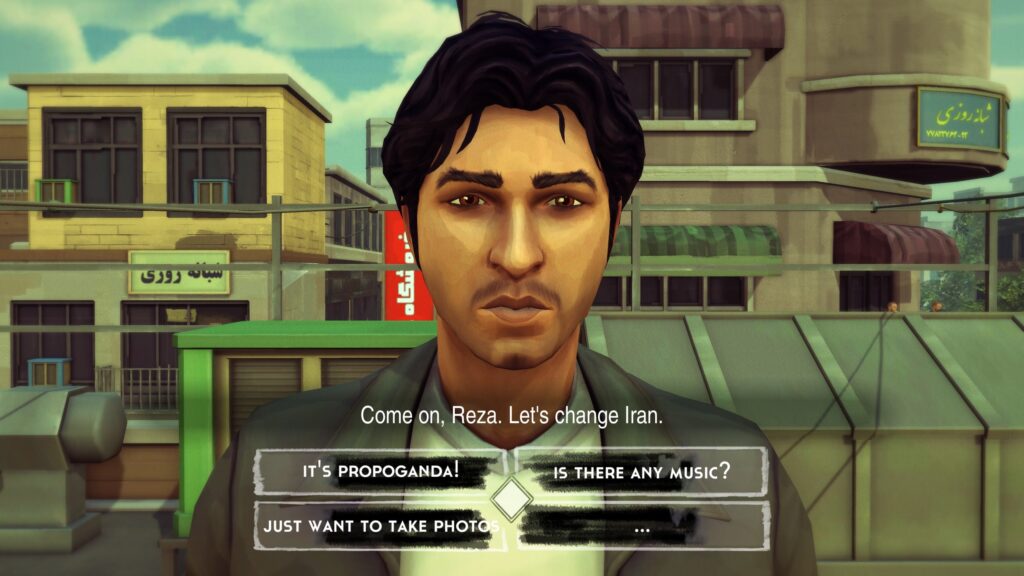
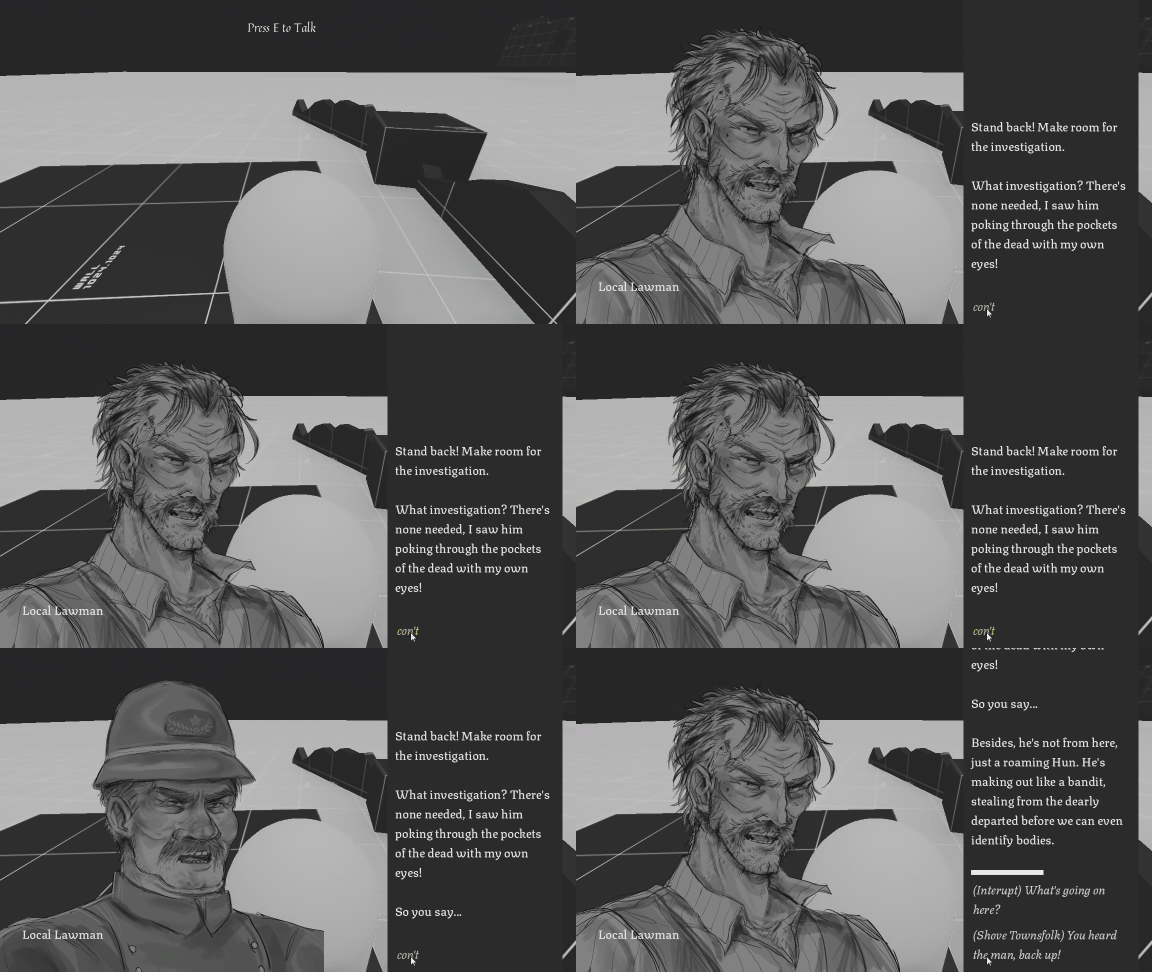
As that option got pushed to the side, I started to consider other ways of putting the player in the position to make difficult choices. One way that I’ve really liked in so-called “canonical” choice-based games like those made by Telltale games, or like Revolution 1979: Black Friday, is to add a timer to choice branches. This not only makes choices feel more urgent, it also can create “non-choice” options where the player is put into a more passive position of “witness.” Implementing this created a good design opportunity to avoid binary branches, and also required me to really drill down into the “difficult” choice of that particular encounter. Even in prototyping this (seen at the very top of this blog), I’ve had to really think about how each option in these timed choices might contain unknown consequences, or result in some story-feedback that either opens or closes future options in that encounter.
But even with timed choices implemented, I still think there are moments in which skill checks might be appropriate in some NPC interactions, especially if you’re trying to advance a quest down a particular path. So I’m not certain if I’m scrapping that previous system entirely, because even in the first little encounters I’ve been writing I can see moments where it would actually make sense. But I think for initial conversations and encounters like the one I highlighted from Norco, doing contested dice rolls or mechanical operations just didn’t feel right.
Like I said at the very top, I did want to share some system design BTS, but I can see that I clearly got a bit sidetracked down this rabbit hole of choice design self-analysis (with maybe some up-side light documentation along the way). So in order to stay faithful to that initial intention, here’s some narrative system design stuff I’m prototyping in Ink:
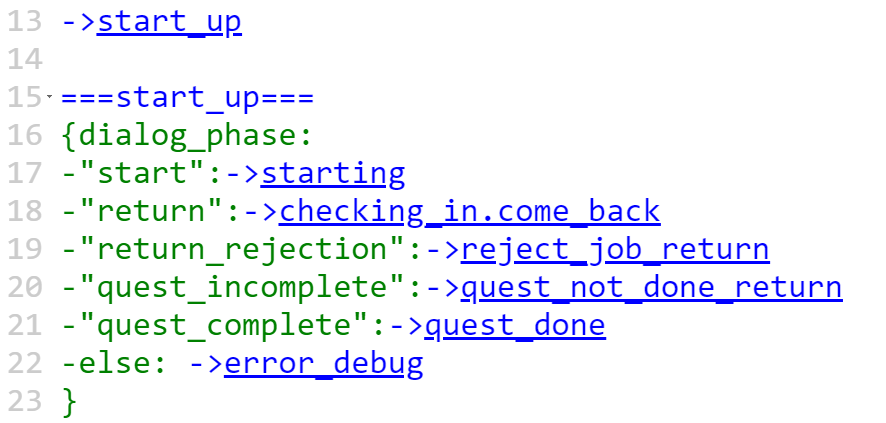
The first “step” is to create a loop-able start-up knot that checks the current dialog_phase variable and routs the player to the correct knot based upon what’s being loaded from a Godot story controller/quest manager. I designed a singleton that’s storing what current step you’re on in a quest and depending on that step (which right now is incremented using an int but needs to be refactored) Godot sets the dialog_phase variable of the story. There’s some additional logic at each “starting point” that you get routed to, including a bit of dialogue randomization, and some other variable “catches” that trigger specific responses from the NPC. But over all, this is the basis for how the story flows.
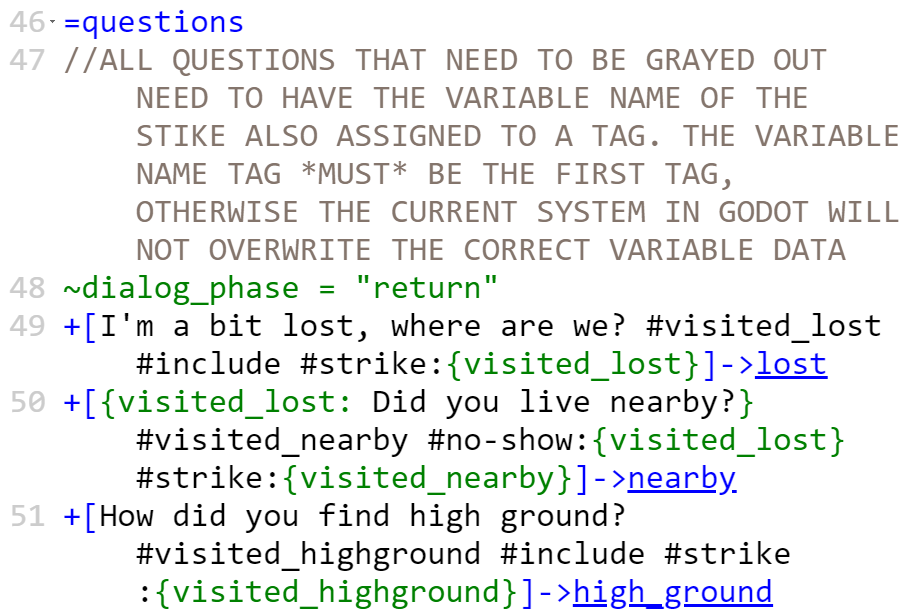
Later in an encounter, you get to a point where you can ask questions after understanding the initial premise of your encounter. This is where I’m trying to incorporate the layer cake technique. Within each option, you get more details or trigger additional aspects of the quest to explore. Eventually (hopefully), those selections map to options becoming more available to you at other encounters related to this quest. An example of this is that if you know how this NPC reached higher ground, you can ask other NPCs if they also did the same thing or some other specific/responsive text. I haven’t completely sorted that out yet, but I’m confident that hooking that up with Godot will be relatively simple since I already have choices triggering signals by activating/advancing quests based on ink tags (see below).
But you might also notice in that screenshot that each one of these choices is using a #strike:{condition}. Each of the variable conditions are a simple bool that gets updated when you select the choice. Then, when you return to the question, if the bool is true, I programmed Godot to disable that choice in order to avoid story redundancies. Right now, I don’t love that you absolutely can’t revisit previous choices, but dynamically changing font stuff in buttons can be a bit tricky (since Godot’s buttons don’t actually include Rich Text BBCode options). But for now, I like how this (systematically) works. I also designed a system to store what choices have been selected on an NPC’s layer cake so that when you leave the conversation and return later, the questions will still be marked as read. That took a bit of configuring, but it boiled down to storing the choices in a dictionary and then checking that dictionary upon returning and mapping it to the strike tag.
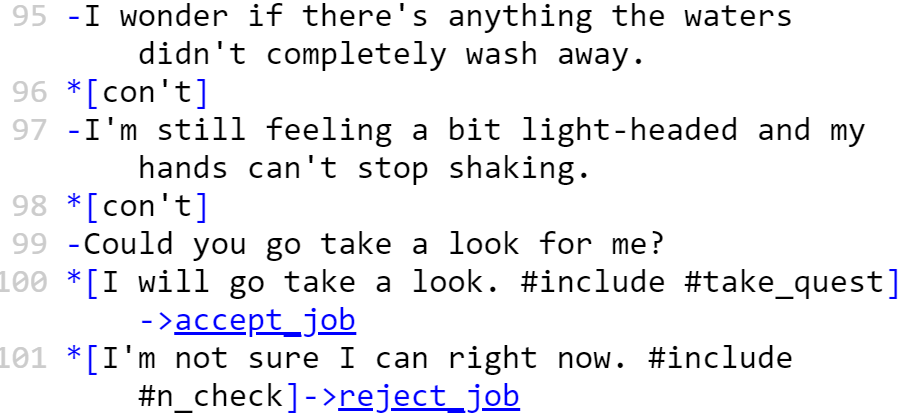
The last lil’ thing in Ink that I’ll show (for now) is that when I get to a point where I want to actually accept a quest, I’m using a tag to activate that quest in Godot. Within the inkgd story script, I’m checking to see what choices have been selected and passing in multiple arguments into that method. One of those arguments is what tags are associated with the choice, and then I use a match block to check if the tag includes take_quest. If is does, then I emit a signal to a Quest Controller singleton which in turn provides some visual feedback to the player that they’ve started a quest using custom Quest resources.
How that system links up to larger UI trackers (like a quest log) is something that I still need to develop… and there are a lot of small QoL game play stuff that still need to be integrated into my coding pipeline, but things are starting to turn the corner from just getting base-line functionality down and starting to actually work on content that employs these systems to full/meaningful effect. I don’t know when I’ll have anything super playable once some of that content starts to come to life just yet, but I’ve been starting to really feel like I need to get some player feedback and input on how these systems feel to someone that doesn’t understand them.
With that, I think I’m going to wrap up. This has already been a bit of an extended post and it’s already pretty niche technical content (lol). BUT keep an eye out for me at the various playtesting events happening around NYC the rest of the Fall and into the Winter, because I’d love to show more of this project and to hear what folks in the community think!


Leave a Reply