I am fresh off of a fantastic weekend at NarraScope, a conference dedicated to interactive storytelling and the craft of narrative design. Held at University of Albany this year, I reflected on the talk I gave this past Saturday morning while taking the train home. Though the talk was recorded and will hopefully be shared online in the coming months, I couldn’t help but think of a question (and my response) that came up in the Interactive Fiction Technology Foundation (the folks who put on the conference) Discord after the event.
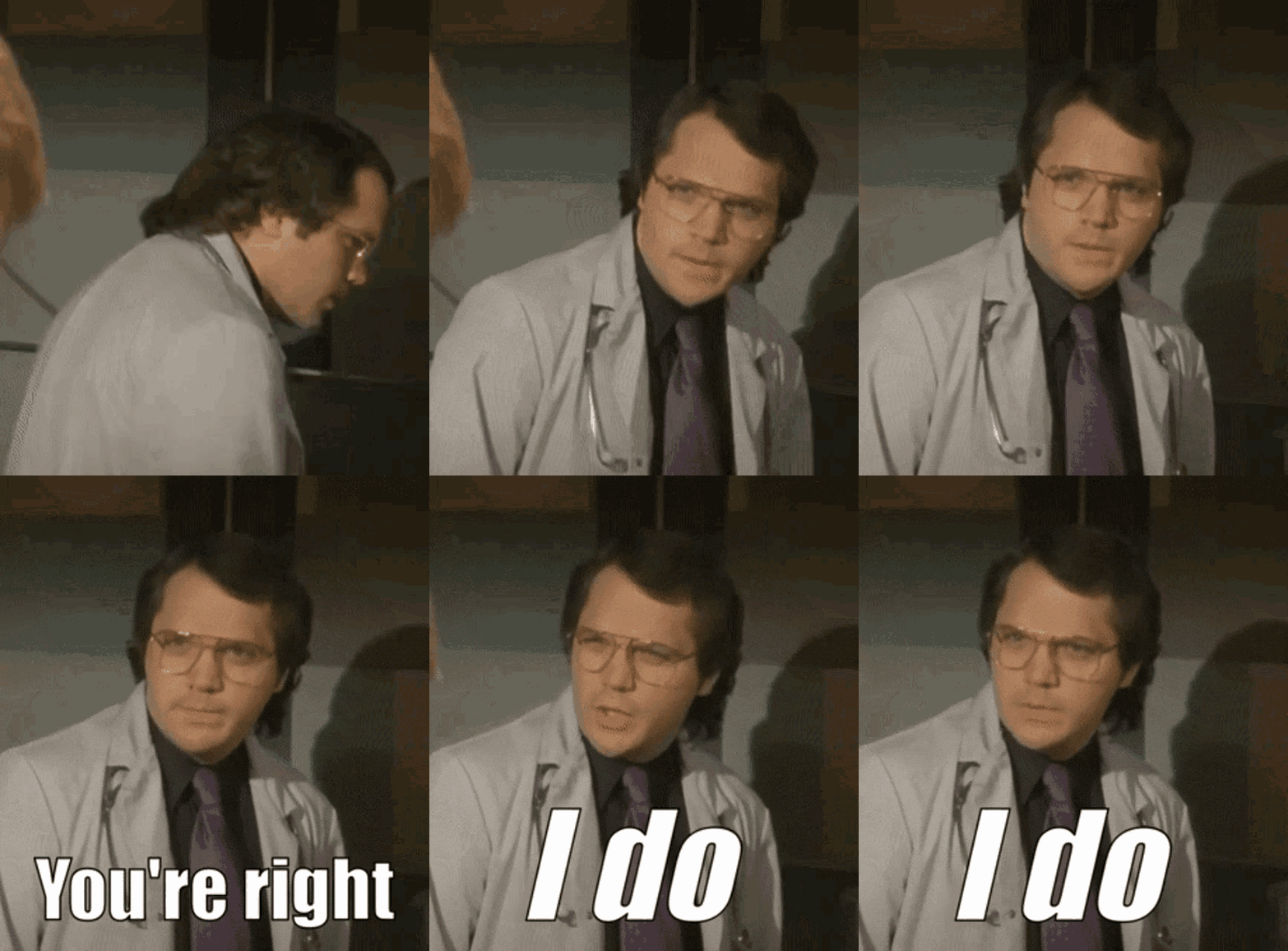
For folks that might not have seen, my talk was entitled I know narrative designers who use branching dialog and they’re all cowards, and it centered on the over-reliance of false choices and branching narrative as a means of placating (or over-indulging) player agency. I intentionally wanted to pose a provocative question/critique of branching narrative and choice to a crowd of narrative designers to spur conversations around alternative storytelling techniques in games that potentially sidestep branching stories that fundamentally don’t change, alter, or compliment gameplay. I also wanted to do this in a way that was lighthearted, so the use of this Garth Marenghi’s often meme’d quote about authors using subtext became a helpful foil for my arguments (I hope). But this topic has been nagging me for a while, and I tried to trace some of the roots of this trend while also giving some so-called canonical examples of where this “cowardly” choice design stemmed from.
Maybe important context here is that I also self-identified as a coward. I made sure that I acknowledged I was just as culpable as anyone of falling into the trap of creating “flavor paths” and that often my stories contained branches that lacked meaningful choice. But after this confession, self-incrimination, and (brief) evidence-backed analysis, I provided three options to consider adopting into future stories:
- Create choice-rich stories that don’t branch (rendering them as linear paths)
- Create completely “meaningless” choices intentionally (to craft poetic paths where players―instead of gameplay/game design systems―determine meaning)
- Create involuntary choices (with potentially rigid design structures that subvert player agency).
I provided some examples for each of these potential options and discussed some pros and cons around why a writer/designer might want to incorporate them into their next project.
But while I was working on this presentation there was an additional option I was considering that I didn’t have enough time to research and provide examples for until RIGHT before my trip up on the train: make impossible choices.
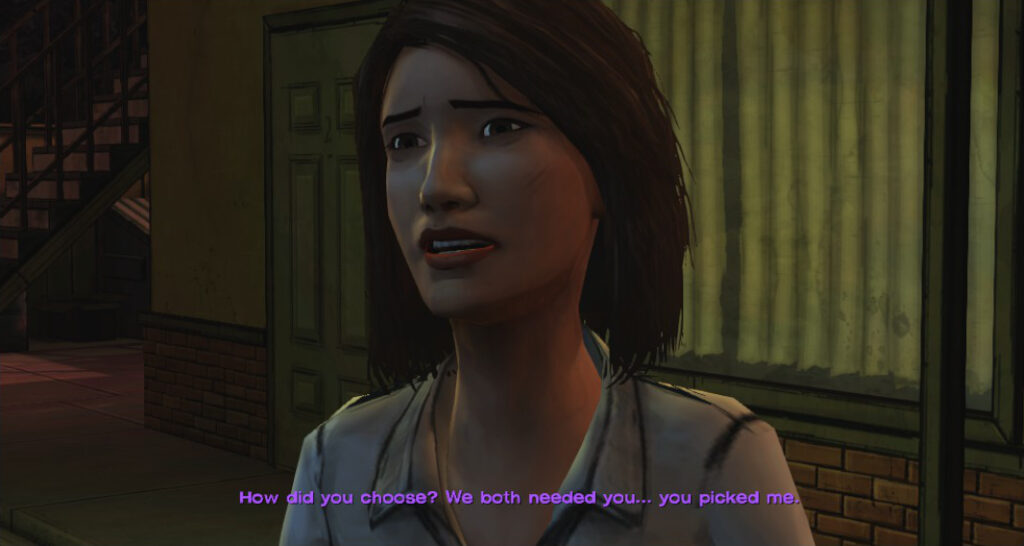
As I talked with others at the conference, I kept coming back to this concept and was a bit sad that I didn’t include it in my talk. But part of the reason was that I didn’t have enough concrete examples that I felt could provide a solid argument for this type of branching dialog that wasn’t inherently trying to either bait the player, be intentionally irreverent, or still fall into some of the traps of meaninglessness that I was trying to critique. As an example, one could look at the choices in The Walking Dead Telltale Games when you have to make specific choices about who to save/rescue during tense zombie attacks. However a problem with the “impossibility” of those choices is that they still kind of end up being couched into a mechanical expression of a system making a definitive branch (i.e. now that an NPC is gone, survivors will reflect on that moment but the player will still continue on to future story beats without much meaningful change to the story).
But why I want to revisit this option now is that I came across a good example of this type of branching choice right before leaving for the conference. I had the great fortune of playing the demo for the upcoming Virtue and a Sledgehammer by Selkie Harbor and Deconstructeam at the Tribeca Film Festival’s games presentation at Pier 57. I noticed, or was reminded, of the excellent choice design these collaborators put into their previous game Many Nights a Whisper. In the short demo I played, the game asks the player some extremely difficult moral questions about stopping a loved one from performing a morally reprehensible act. The game asks you to what extent you’d try to stop them from following through with those actions, and the weightiness of those choices really struck me.
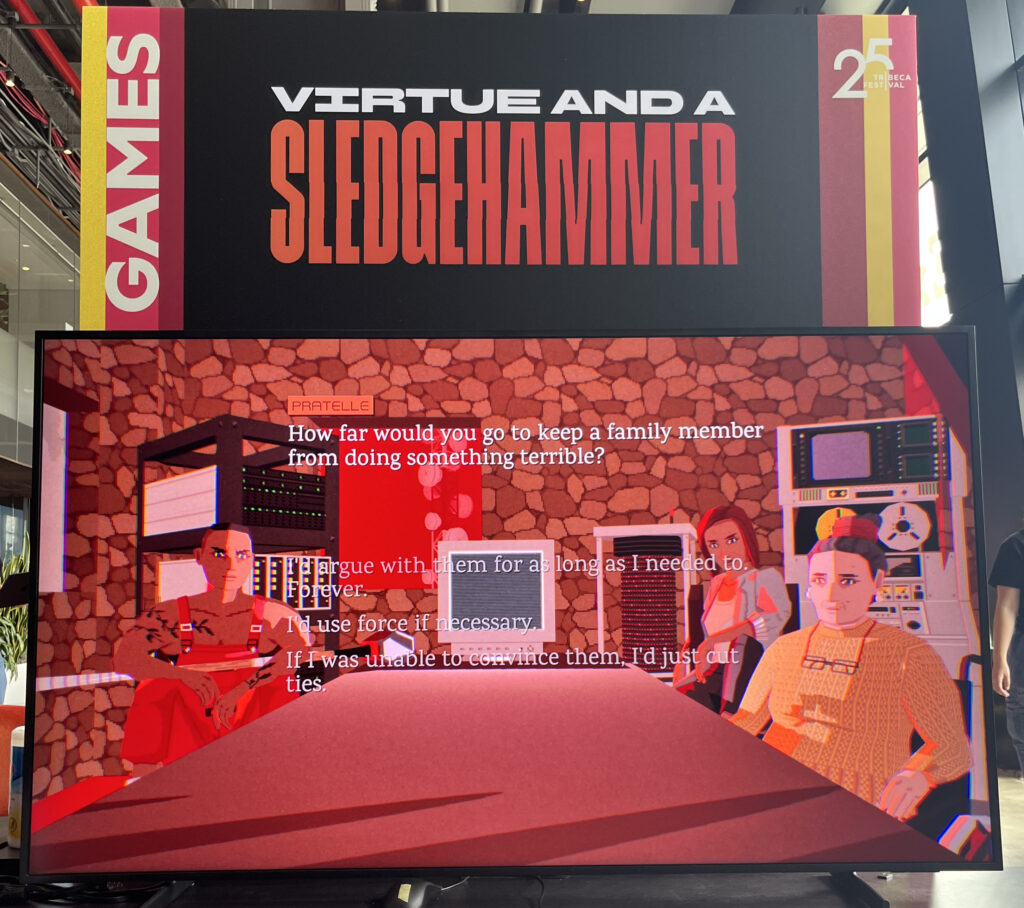
All the options and responses to these probing questions felt… impossible to a certain degree. My discomfort with having to choose made me really reflect on making my selection and advancing the story. It did something that I think the “meaningless” options described above does really well: makes the player evaluate their choices based on external feelings rather than an in-game mechanical/storytelling rationale. But because the options provided had no particular upside, or because of the complex, knotty, interpersonal nature of the initial “quizzing” from NPCs (who you immediately realize are your family, adding an additional wrinkle to the context of the question), the player is put into a situation where the resulting choice feels meaningful to the player-character.
I was reminded after talking about this with other NarraScope attendees that Many Nights a Whisper has similar moments of difficult/impossible choice design. You are tasked with listening to the confessions and wishes of community members before an important ritual that you have been training your whole life for. During these segments, villagers come to whisper their wishes to you, hoping that you will grant their desires as part of a sacred ritual. These wishes range in subject matter, but my memory of them is that they tended to weigh individual needs and dreams against the collective responsibility of your community. Thus the choices of granting a townsfolk’s wish would sometimes require making complicated moral decisions, ones that didn’t have completely black or white outcomes. Instead these wishes become moments of meditation where the player is asked the insert themselves into the scenario and bring their out-of-game perspective on any given request.
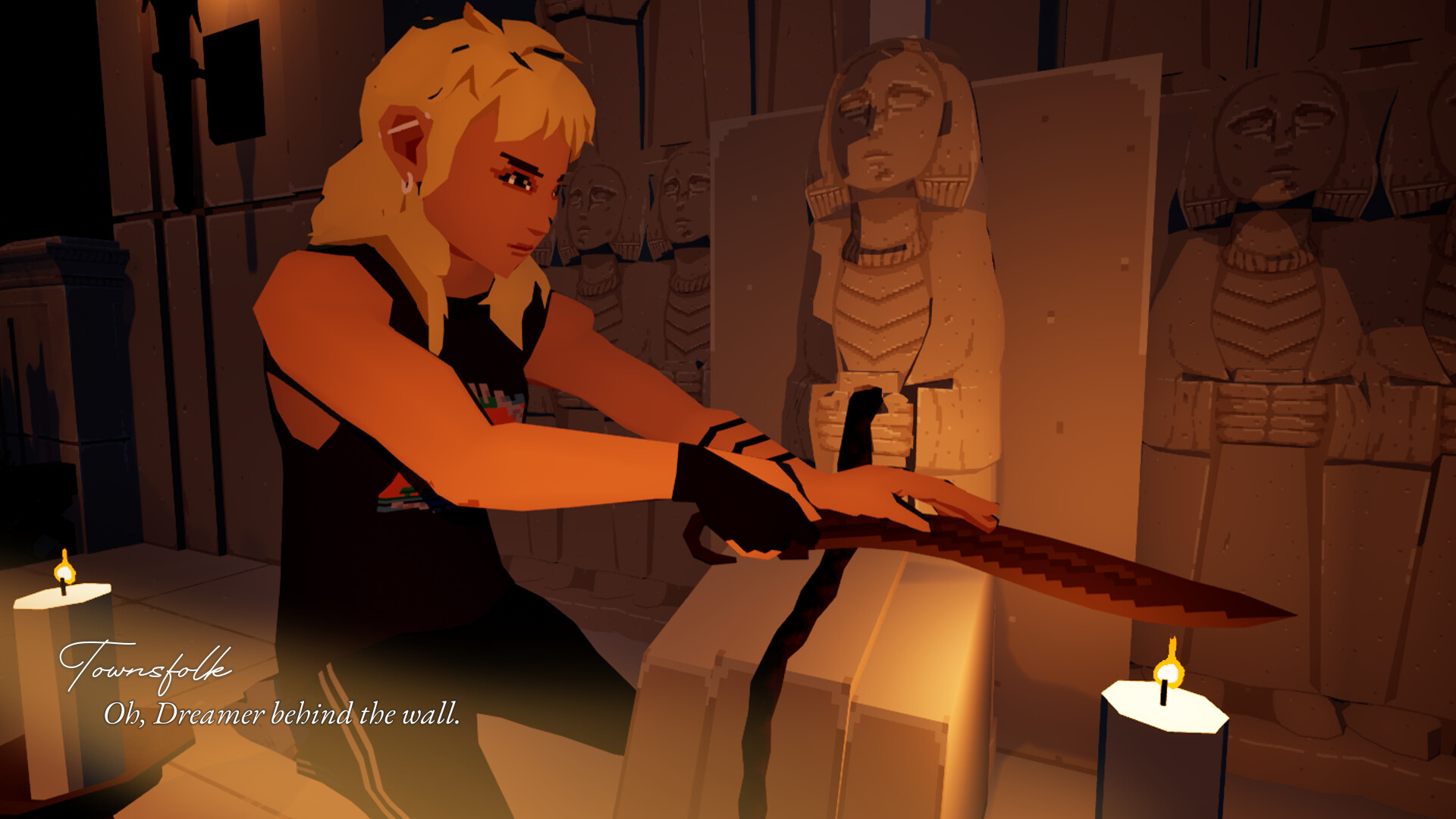
The choices presented in these two games have meaningful because “correctness” and the “golden path” can only be decided by the individual player. Additionally, the system design does not evaluate the choice like in other traditional branching narrative games that assign value and/or stats (which I address in my original talk). What remains in these branching moments are opportunities for reflection, contemplation, and inward assessment of the power of interactive choice. In Virtue and a Sledgehammer, your choices get rebuffed by your family/crew, testing your mettle, biting-back at your agency, demanding the player-character to consider the level of their conviction. This formulation gives the designers a chance to speak more directly to the player-character while progressing the story and developing the characters. It adds layers of detail while setting tone.
Unlike the “meaningless” option, choices are evaluated; but it’s not by a system, it’s by the story. The meaningfulness of that choice is then reflected in the narrative response. Which, from a writers perspective, shouldn’t be all that surprising. A player-based choice should elicit a response from the world and the NPCs, but typically this is smoothed over by using a bottle-necking technique to readjust variation back onto a central path. Instead, what I feel like is happening here is that my bad/impossible choices dead end; branches don’t continue because the “right” choice is never offered. The scenario, story, and NPCs can’t present you with it at that moment. I’m left feeling like my choice mattered because it came from me as a person exercising my morals, but strangely, my choice also didn’t matter because the character I’m playing doesn’t have the capacity to answer correctly.
The tension that arises from that offering-denial in these brief exchanges tells me so much about the story, the characters, the scenario, and the kinds of social/moral questions the game (and by extension it’s designers) is (are) going to continue to confront me about as I progress. It’s remarkable staging in a relatively concise package; and maybe the best option as a way forward for building on the tradition of branching narratives to tell meaningful and complicated stories.
In closing, I want to thank all of the organizers and volunteers of NarraScope. It’s truly a special event that brings together some really amazing people and I feel deeply honored to be included. I’d also like to thank the many folks that came to my talk, asked questions, and continued the conversation with me over the weekend. It was truly a delight to give my talk and be in attendance and I can’t wait to share more of this research with others soon!
Leave a Reply